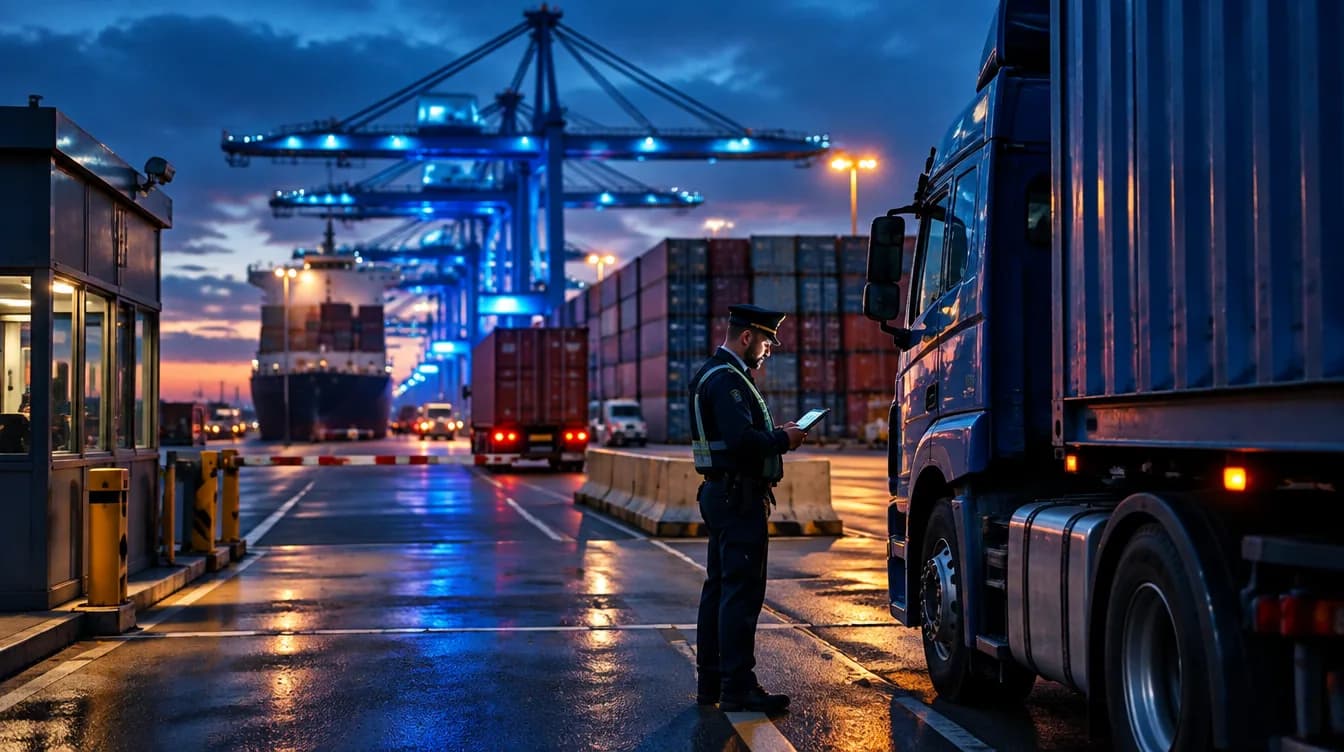
TechFides: May 2026
A customs commissioner of a Central African nation told me earlier this year that his administration was losing somewhere between 10 and 20 percent of its tariff revenue every quarter to under-declaration. He said it with no hesitation. He had the operational intuition. What he did not have was data he could put in front of his Minister of Finance to prove it.
The problem was not that the under-declaration was invisible. The problem was that the declaration data, the trade data, and the operational intelligence to detect anomalies lived in three different systems, and two of those systems were hosted by vendors outside his jurisdiction.
This is the structural gap at the center of customs modernization across Africa and the Caribbean. The ASYCUDA platforms work. The customs codes are aligned to international frameworks. The staffing levels are sometimes adequate. What is missing is the sovereign data layer that lets a customs commissioner answer his Minister with numbers instead of intuition.
This is the blueprint for closing that gap, and recovering the revenue.
The revenue at stake
Across African and Caribbean customs administrations, the revenue assurance opportunity is large enough to be measurable on the national budget.
Tariff revenue typically represents 15 to 35 percent of total government revenue in countries where the customs administration is operationally significant. For some West and Central African nations, the share is higher.
Revenue leakage from under-declaration, mis-classification, and origin gaming runs at 10 to 20 percent of the tariff base in typical conditions. World Bank and IMF technical assistance reports across the past decade have converged on this range.
The annual loss for a mid-sized coastal nation with $500 million in annual import value and a 12 percent average tariff is roughly $60 million in tariff revenue per year. A 15 percent leakage rate represents $9 million annually lost, and recoverable.
Across the African continent, total customs revenue leakage is estimated at $25 to $50 billion annually. The number depends on which study you cite and how strictly you define leakage, but the lower bound alone represents a transformational fiscal opportunity if recovered.
These numbers are the financial argument for sovereign customs modernization. The operational argument is harder to quantify but equally important: customs is where trade policy meets ground truth. A customs administration that cannot see its own data cannot enforce its own policy.
Why ASYCUDA alone is not sufficient
I want to be precise about ASYCUDA, because the platform deserves both credit and a clear-eyed assessment.
What ASYCUDA does well. UNCTAD's Automated System for Customs Data is the most widely deployed customs management platform in Africa and the Caribbean, present in over 90 countries. It standardizes declaration processing, integrates with trade reference data, supports the World Customs Organization data model, and provides a baseline level of automation that would otherwise require national-level platform development.
What ASYCUDA is not. ASYCUDA is a customs management platform, not a revenue assurance platform. It processes declarations. It does not, by default, run intelligent risk scoring on declarations. It does not detect anomaly patterns across thousands of historical clearances. It does not flag origin-gaming attempts in real time. It does not maintain a national risk model that learns from every clearance.
The risk scoring layer is something each customs administration is expected to develop, configure, and operate on top of ASYCUDA. In practice, most administrations run rule-based risk modules with a small number of static rules. The static rules catch the obvious cases. They miss the cases that matter, the cases where the gaming is sophisticated enough to evade fixed-threshold rules.
This is the gap AI-based risk scoring fills. And it is the gap that turns a competent customs administration into a high-performance revenue assurance operation.
The sovereign customs architecture
What does sovereign customs infrastructure actually look like? Five components, layered on top of the existing ASYCUDA foundation.
Layer 1: A sovereign data platform inside the country. One consolidated platform holding declaration data, trade reference data, broker submissions, container manifests, inspection records, and clearance decisions. Hosted on hardware located inside the customs administration's perimeter. Not in a vendor's cloud. Not in a region tagged "customs-friendly."
Layer 2: AI-based risk scoring trained on national data. Models that score each declaration in real time against:
- Historical patterns from the customs administration's own data.
- Trade reference data (HS codes, country-of-origin reference values, market prices).
- Broker behavior patterns (which brokers, which importers, which commodities).
- Geopolitical and supply-chain context (sanctions, embargoes, trade agreement origin rules).
The models run on customs-controlled hardware. No declaration data is sent to a third-party API. The risk scores feed back into the ASYCUDA risk module as enriched signals for selectivity.
Layer 3: Container and shipment tracking. Integration with vessel monitoring (where applicable), port operating systems, and broker systems. The customs administration sees the shipment trail before the declaration arrives, not after.
Layer 4: Revenue assurance dashboards for the commissioner and the minister. Real-time visibility on declared duty, expected duty (modeled from declaration plus risk-adjusted expected value), and the gap. Trend analysis. Broker-level performance. Commodity-level anomalies. The dashboard a customs commissioner walks into the Minister of Finance's office with.
Layer 5: Audit-ready by design. Every decision logged. Every risk score reasoned. Every override documented. The customs administration can defend its risk-based selectivity to its own oversight bodies, to the IMF, and to the WCO Compliance and Enforcement Committee.
This architecture is what TechFides AEGIS Government & Institutional Tier deploys for customs administrations. The same architecture supports neighboring sectors, fisheries, mining, forestry, agriculture, because the underlying data sovereignty pattern is identical.
The funding paths that work
For most African and Caribbean customs administrations, the budget for the full architecture above does not come from the national operating budget alone. It comes from a blend.
World Bank Trade Facilitation Programs. The Trade Facilitation Support Program (TFSP) and country-specific Development Policy Operations regularly fund customs modernization. These programs are familiar with the architecture and the implementation partners. Increasingly, they prefer sovereign-hosting requirements.
African Development Bank Trade Finance and Regional Integration. AfDB has been increasingly active in customs modernization, particularly in the context of the African Continental Free Trade Area (AfCFTA) implementation.
EU Sustainable Trade Programs. The EU's trade facilitation envelope for ACP countries includes customs modernization. EU funding increasingly prioritizes data sovereignty as a precondition.
US Bilateral Programs. The DFC (Development Finance Corporation), USTDA (Trade and Development Agency), and EXIM Bank all have channels that can fund customs-related infrastructure when the U.S. commercial partner is a meaningful component of the supply chain.
IMF Technical Assistance. Not direct funding, but the IMF AFRITAC technical assistance centers and the Fiscal Affairs Department regularly support customs modernization with technical advisors who can shape the procurement specifications to favor sovereign architectures.
Customer-pays models. Increasingly, customs administrations are exploring revenue-share or BOT (Build-Operate-Transfer) structures where the implementation partner is paid from a percentage of recovered revenue. This works best for politically stable administrations with strong oversight, because the financial alignment can create both incentives and risks that require careful contract structure.
The right funding structure depends on the country, the political calendar, and the commissioner's existing relationships. TechFides operates across all of these channels with the AEGIS Government & Institutional Tier sized to fit the funding envelope.
What the deployment sequence looks like
The deployment for a customs administration follows the standard TechFides Government practice phased approach, scoped for the customs context.
Phase 1: AI Readiness 360 diagnostic. 15-day network-level assessment. For a customs administration, this typically maps current ASYCUDA configuration, declaration volumes, broker landscape, existing risk-module rules, IT infrastructure, and team capability.
Phase 2: Feasibility study and reference architecture. 4 to 8 weeks. Maps the specific revenue assurance opportunities, regulatory environment, donor relationships, and political calendar. Output: feasibility study, architecture plan, budget, timeline, risk register.
Phase 3: Pilot deployment. 3 to 6 months. Typically deployed at the largest port or border crossing first. Sovereign data platform stood up. AI risk scoring integrated with ASYCUDA. Initial dashboards live. Measurable revenue assurance improvement within the pilot period.
Phase 4: National rollout. 12 to 24 months. Expansion across all major ports, airports, and border crossings. Full integration with broker systems and port operations. National-scale risk model. Cross-border data sharing under regional customs frameworks.
Sustained support. Custom retainer for ongoing model retraining, regulatory adaptation, and capability reinforcement.
The architecture is country-agnostic. The implementation is calibrated to each administration's operational reality. The financial recovery from Phase 3 alone, in most pilots, is enough to justify Phase 4 from the customs administration's own budget, even before donor co-financing is considered.
The strategic question for a customs commissioner
If you are reading this and your role is Director General of Customs, Commissioner of Customs and Excise, Permanent Secretary at the Ministry of Finance, or program lead at the World Bank, AfDB, IMF, or a bilateral program, the strategic question is small but specific.
"At the end of the next budget cycle, will the data telling us what is leaking through our borders belong to our administration, or to a vendor?"
If the answer is a vendor, the revenue assurance program will produce a dashboard but not a permanent capability. The next donor cycle will fund a different vendor with a different dashboard. The leakage will continue at roughly the same rate.
If the answer is the administration, the revenue assurance becomes a permanent national capability. The data layer feeds tax policy, trade negotiation, and economic statistics in addition to customs. The dashboard the Commissioner walks into the Minister of Finance's office with becomes the data layer for the national budget itself.
Sovereign customs is not an IT decision. It is a fiscal sovereignty decision. The numbers: 10 to 20 percent of tariff revenue, $9 million per year per mid-sized economy, $25 to $50 billion across the continent, make it one of the highest-leverage decisions a finance minister can make in 2026 and 2027.
The full TechFides Government practice and the AEGIS Government & Institutional Tier are at techfides.com/government.
For customs commissioners, finance ministers, and donor program leads exploring sovereign customs infrastructure, Request a Briefing. The first conversation is a 30-minute briefing with TechFides leadership at the appropriate time.
Like this? Get the next one Wednesday.
One email per week. No marketing filler. Unsubscribe anytime.
Government practice.
Sovereign digital infrastructure for the agencies that run a nation's missions.