TechFides · July 2026
The digital business card has one job, and most tools do exactly that job. You tap a phone, your name and number land in someone's contacts, and everyone moves on. It's a nicer way to hand over a rectangle. It isn't a nicer way to do business.
So if you're comparing Popl, Blinq, and HiHello, you're really comparing three good versions of the same small idea. Here's how they stack up against each other, and against a card built to do the part that actually makes money.
What does a digital business card actually do?
Popl, Blinq, and HiHello all do the same core thing, and they do it well. They replace the paper card. You get a branded profile, a tap to save your contact, a QR code, and some basic analytics on who looked. For the price of a coffee a month, that's a fair trade.
But look at where all three stop. They hand over your contact details and then go quiet. That's the exact moment the real work starts. Who did you meet, and why did it matter? What did you promise them? Which of those introductions turned into money? None of these tools can tell you, because none of them were built to.
How much do Popl, Blinq, and HiHello cost?
In 2026 the commodity card market sits in a tight band:
| Platform | Team pricing | What you get |
|---|---|---|
| Blinq | about $5 per user a month | Digital card, contact capture, basic analytics |
| HiHello | $5 to $12 per user a month | Digital card, scanning, team management |
| Popl | $4 to $13 per user a month | Digital card, lead capture, CRM sync |
| TechFides SmartCard | $12 per seat a month | Everything above, plus meeting capture, AI follow up, revenue attribution, traveler safety, and data that stays on your device |
On the surface, SmartCard costs a little more than the commodity cards. That comparison only holds if you think the card's job ends at hello. It doesn't.
What makes SmartCard different?
SmartCard goes to work the second someone taps it. It logs where you met and why. It takes the notes. It drafts the follow up before you reach the parking lot, and you just approve and send. Every handshake gets tied to the revenue it eventually produces, so you finally know which rooms are worth your time.
It travels, too. Walk into a meeting in a city you've never visited and the card briefs you first: your last conversation, their priorities, and the pipeline contacts already nearby. Land in another country and it surfaces health advisories, entry rules, and current risk on the ground. For a company sending people abroad, that's duty of care you can actually prove.
And it's yours. Your notes, your contacts, your whole relationship graph stay encrypted on your own device. They don't sit on a card vendor's platform. A tool that keeps your entire network on someone else's server isn't an asset you own. It's a subscription you rent.
Should you price it like a card, or like a CRM seat?
That's the real question. A CRM seat runs $25 to $150 a month, and it still leaves the data entry, the notes, and the follow up to you. SmartCard is $12 a seat and does that work for you. Next to a card, it looks expensive. Next to what it replaces, a CRM seat plus the deals you lose to follow ups that never happen, it's the cheapest revenue tool in your pocket.
Popl and Blinq hand someone your details and stop. SmartCard captures the moment, briefs you before the meeting, watches your back abroad, and ties every introduction to revenue. Same shape. Different product.
Own Your AI
TechFides builds technology you own instead of rent. AI that runs on hardware you control, with your data staying where you keep it. SmartCard is that idea in card form. It pays for itself the first deal it closes.
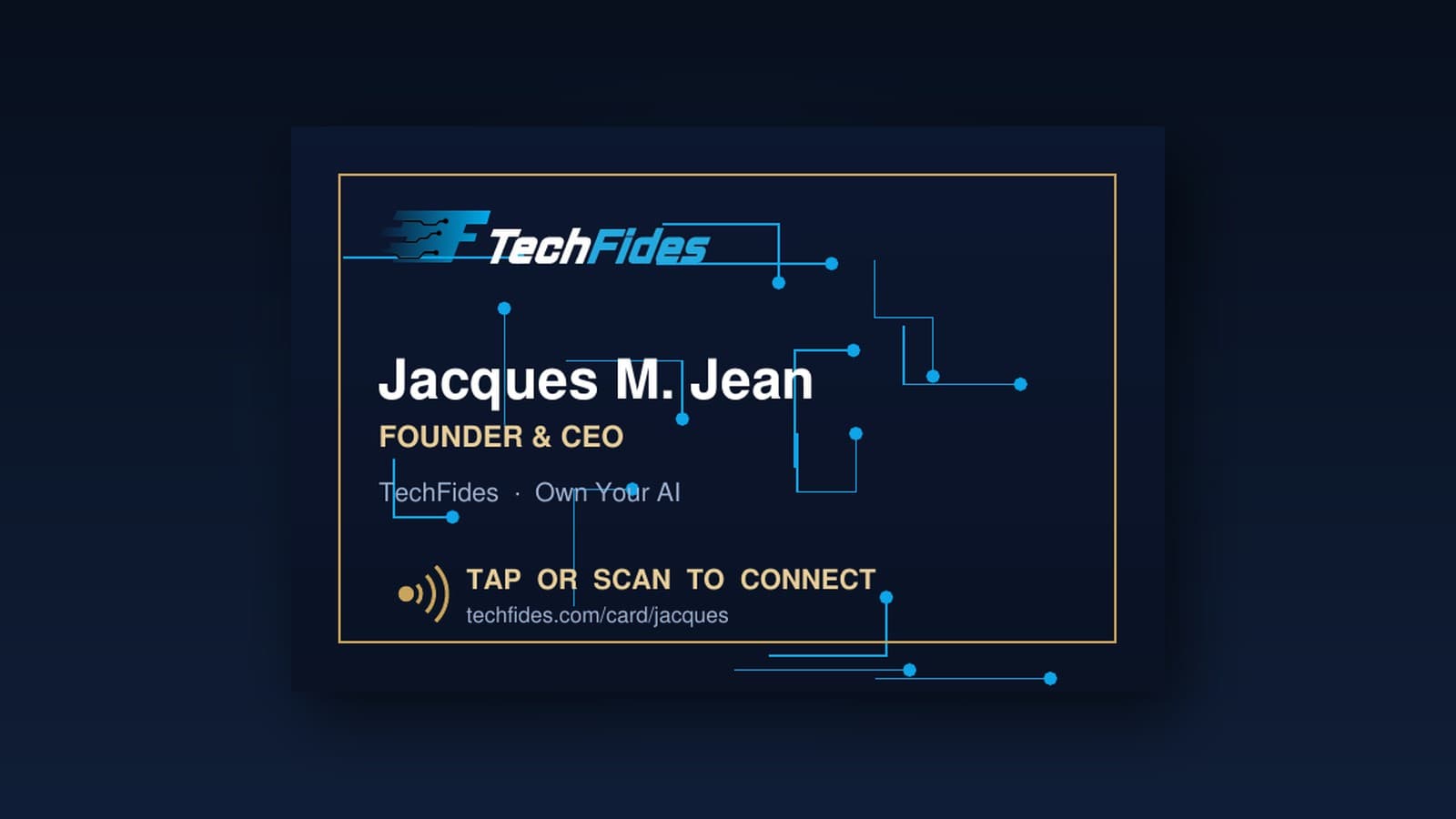
See a live card at techfides.com/card/jacques, or look at the full lineup at techfides.com/smartcard.
Like this? Get the next one Wednesday.
One email per week. No marketing filler. Unsubscribe anytime.