TechFides: June 2026
Private AI is artificial intelligence that runs on hardware you own, inside your own building, on your own network. Your documents and questions are processed locally and never sent to an outside company. That's the whole idea: the same kind of AI you already use, but it stays in the building instead of going out to someone else's servers.
If that sounds like a small distinction, it isn't. It changes who controls your data, what your AI costs as you grow, and whether you own the tool or just rent access to it. This guide walks through what private AI is, how it's different from the cloud AI most businesses use today, and when it actually makes sense.
The short version
Most AI today is cloud AI. When you type into ChatGPT, Microsoft Copilot, or Claude, your words travel over the internet to a data center owned by that company. The AI does its work there, and the answer comes back to you. It's fast and easy. But your information left the building to make it happen, and you pay a monthly fee, usually per person, for the privilege.
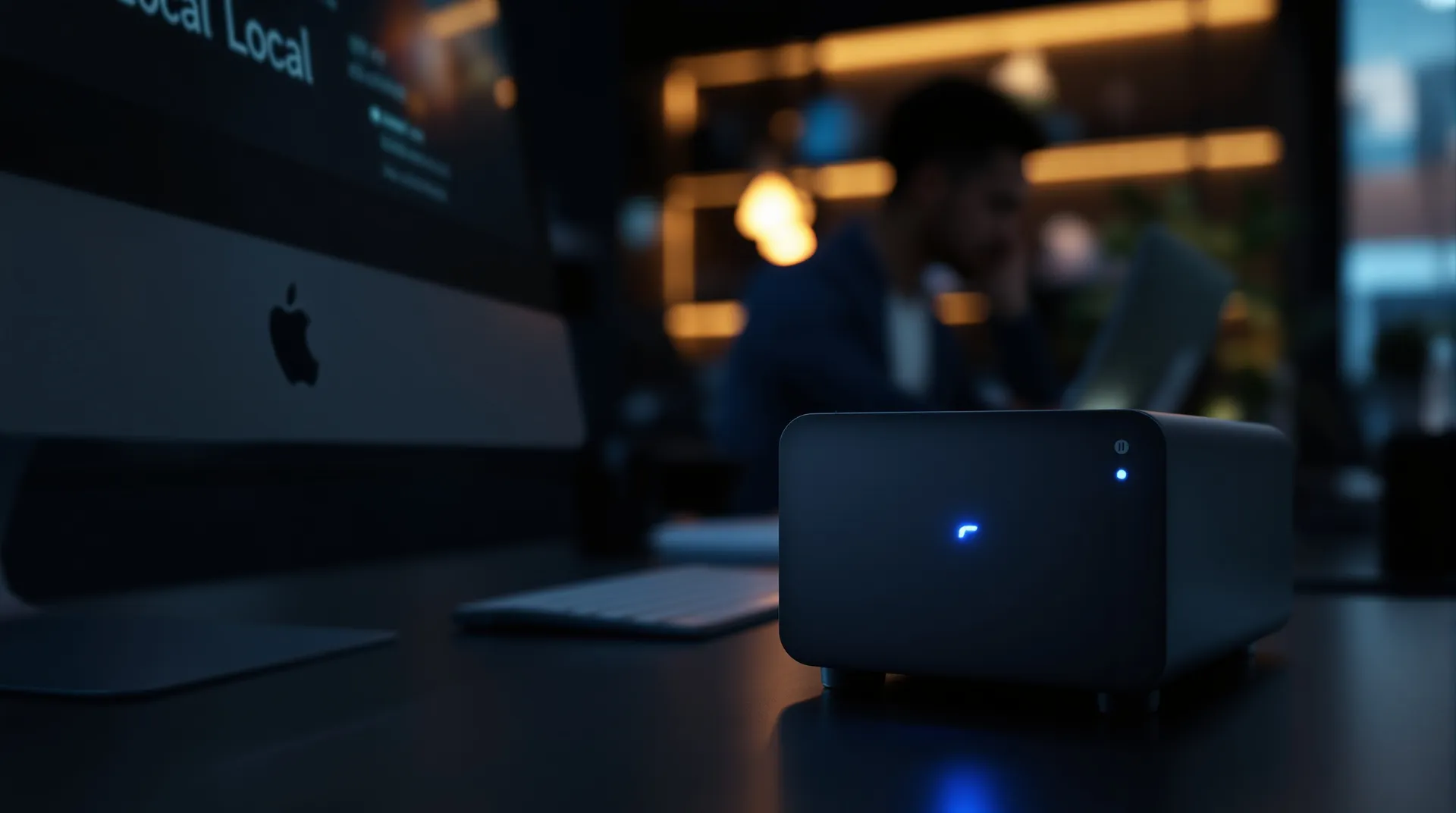
Private AI flips that. The AI model lives on a device in your office, sometimes a small server, sometimes a computer no bigger than a paperback book. It reads your files, drafts your emails, and answers your questions right there on site. Nothing crosses the internet. Nobody else sees your data. And because you own the hardware, using it more doesn't cost you more.
Private AI vs. cloud AI: the real difference
People assume the difference is technical. It isn't, really, both run capable models. The difference is about control, cost, and ownership.
Where your data goes. With cloud AI, every prompt is a small deposit into a system you don't control. With private AI, your data never leaves your network. For a law firm that's client privilege; for a medical office it's a HIPAA question; for a dealership it's customer financial data. Private AI keeps all of it inside your walls.
How the bill behaves. Cloud AI is usually priced per seat or per use, so the bill grows with every new hire and every busy month. You get punished for adoption. Private AI is a flat cost, you add people and usage without the price climbing.
Who owns the tool. With cloud AI you're a tenant. When the vendor raises prices or changes terms, you have no move. With private AI, the hardware and the deployment are yours.
We wrote a deeper side-by-side breakdown here: Private AI vs. Cloud AI.
What can you actually do with private AI?
The same things you'd use any business AI for, just without the data leaving:
- Draft and review documents. Contracts, proposals, reports, letters, written or checked in seconds.
- Summarize and search your own files. Ask questions about your case files, patient charts, deal jackets, or job histories and get answers grounded in your records.
- Cut admin time. Meeting notes, follow-up emails, intake forms, scheduling, the busywork that eats your team's day.
- Analyze your numbers. Margins, pricing, job costs, trends, using your real data, kept private.
A physician finishes a visit and the notes are already drafted. An estimator drops three months of job costs in and asks where the margin leaked. An associate flags every non-standard clause in a 90-page contract in seconds. None of it ever touches the cloud.
Is private AI as good as ChatGPT?
This is the question everyone asks, and the honest answer is: for the work most businesses do, yes. Open models like Llama 3 and Mistral, tuned on your own documents, handle drafting, summarizing, research, and analysis very well. For the rare task that genuinely needs a frontier model, a private setup can route to a hosted model as a fallback.
Capability is rarely the real deciding factor. Control of your data and the shape of your costs usually are.
What does private AI cost?
TechFides prices it as a one-time setup fee plus a flat monthly, no usage meters, no per-seat fees, and you own the hardware:
- Sovereign S: $5,000 setup, then $500/mo (solo and small offices)
- Sovereign M: $10,000 setup, then $1,000/mo (a whole team, one site)
- Sovereign L: $15,000+ setup, then $2,500/mo (multi-site and larger teams)
For a small team, cloud AI can look cheaper at first. As your team and usage grow, owning your AI pulls ahead, and at the end you own the hardware. The pricing page has a calculator that shows the 36-month picture.
When private AI is the right call, and when it isn't
We'd rather tell you the truth than sell you the wrong thing.
Private AI makes sense when your data is sensitive or regulated, when per-seat cloud costs climb as you grow, when you need AI that works whether or not the internet is up, or when you simply want to own your tools instead of renting them.
Cloud AI is fine when your data isn't sensitive, your usage is light, and you don't mind a bill that grows with you. For a two-person shop running general tasks, renting is perfectly reasonable, and we'll say so.
How TechFides does it
We handle the whole thing. We size the hardware to your work, set it up on site, load and tune the AI on your documents, and support it month to month. You don't manage servers or learn a dashboard. You just have AI that works, on hardware you own, with your data staying exactly where it belongs.
If you're not sure whether private AI fits your business, take the free AI Ownership Test. Eight questions, two minutes, no signup. We'll tell you honestly whether it's worth it for you, or whether you're better off where you are.
Like this? Get the next one Wednesday.
One email per week. No marketing filler. Unsubscribe anytime.