TechFides: June 2026
"Run AI in my own building" sounds like it requires a server room, a cooling system, and an IT department. For most businesses, it doesn't. The hardware that runs private AI today is smaller, quieter, and cheaper than people expect, and right-sizing it is the difference between a smart purchase and an expensive one.
Here's what's actually under the hood.
The three sizes, in plain terms
Private AI hardware comes in roughly three tiers, and most small and mid-size businesses live in the first two.
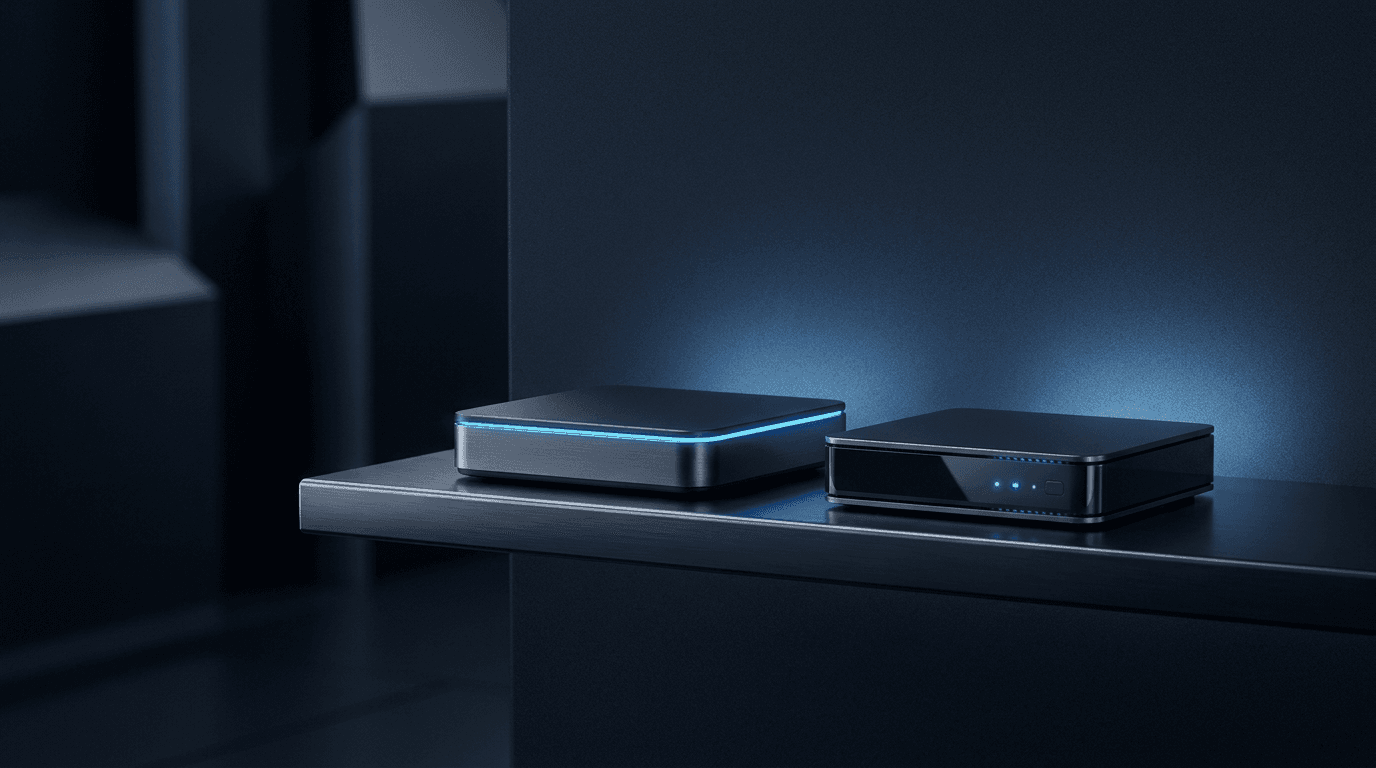
A compact device. For a solo office or a small team with everyday needs, drafting, summarizing, answering questions about your files, the work can run on a device about the size of a paperback book sitting on a shelf. It sips power, makes no noise, and handles a real workload.
A small server or workstation. For a busy office with several people hitting the AI at once, or heavier documents, you step up to a small server or a workstation-class machine. Still fits in a closet or under a desk. Still nothing you need a technician on staff to babysit.
A larger on-site system. For a multi-location business, a heavy-volume operation, or work that needs the biggest models, you scale up to a more serious box. This is the top end for an SMB, and most never need it.
The honest headline: the gap between "I want private AI" and "I have the hardware for it" is much smaller than the brochures from the big-box vendors suggest.
What the hardware is actually doing
The reason AI wants specific hardware comes down to one part: the GPU, the chip originally built for graphics that turns out to be excellent at the math AI runs on. A good GPU (or the unified memory in some modern compact machines) is what lets the model think quickly.
More GPU, more memory, faster answers and bigger models. That's the whole trade. Matching that to your actual workload, not the biggest spec on the shelf, is how you avoid overpaying for capacity you'll never use.
How to right-size without guessing
Buying too small means a sluggish tool your team abandons. Buying too big means money parked in idle silicon. The right size comes from three honest questions:
- How many people use it at once? One person at a time is a very different machine than ten.
- How heavy is the work? Short prompts and quick answers are light. Long documents and deep analysis are heavy.
- Does the data have to stay fully in the building? If yes, you're running everything locally, which shapes the spec.
Answer those and the hardware almost picks itself. You don't need the most powerful machine. You need the one that fits your work with a little room to grow.
Why owning the box matters
Here's the part the cloud can't offer: when the hardware is yours, the cost stops. You buy it once (or it's included in a flat monthly, see what private AI costs), and using it more doesn't cost more. No meter. No per-call bill that climbs as your team adopts the tool.
And because it's physically in your building, it works when the internet doesn't. The AI is on the shelf. So is the power. That's the whole point of owning it.
How we handle it
TechFides is hardware-agnostic, we'll run your private AI on a Mac, a Windows machine, a small server, or a compact device, whatever fits your work and your budget. We spec it to your actual workload, install it, and include it in a flat monthly so there's no five-figure equipment gamble up front.
You don't need a data center to own your AI. You need the right box, sized to your work, sitting in your building. Own your AI, on hardware that fits.
Like this? Get the next one Wednesday.
One email per week. No marketing filler. Unsubscribe anytime.