TechFides: June 2026
Most AI advice lives on a spectrum from "convenient" to "careful." Air-gapped AI is for the businesses at the far end, the ones where the answer isn't "be careful with the data," it's "the data does not leave, ever."
If that's you, you've probably been told you simply can't use modern AI. That's not true. You can. You just have to understand one idea first.
What "air-gapped" actually means
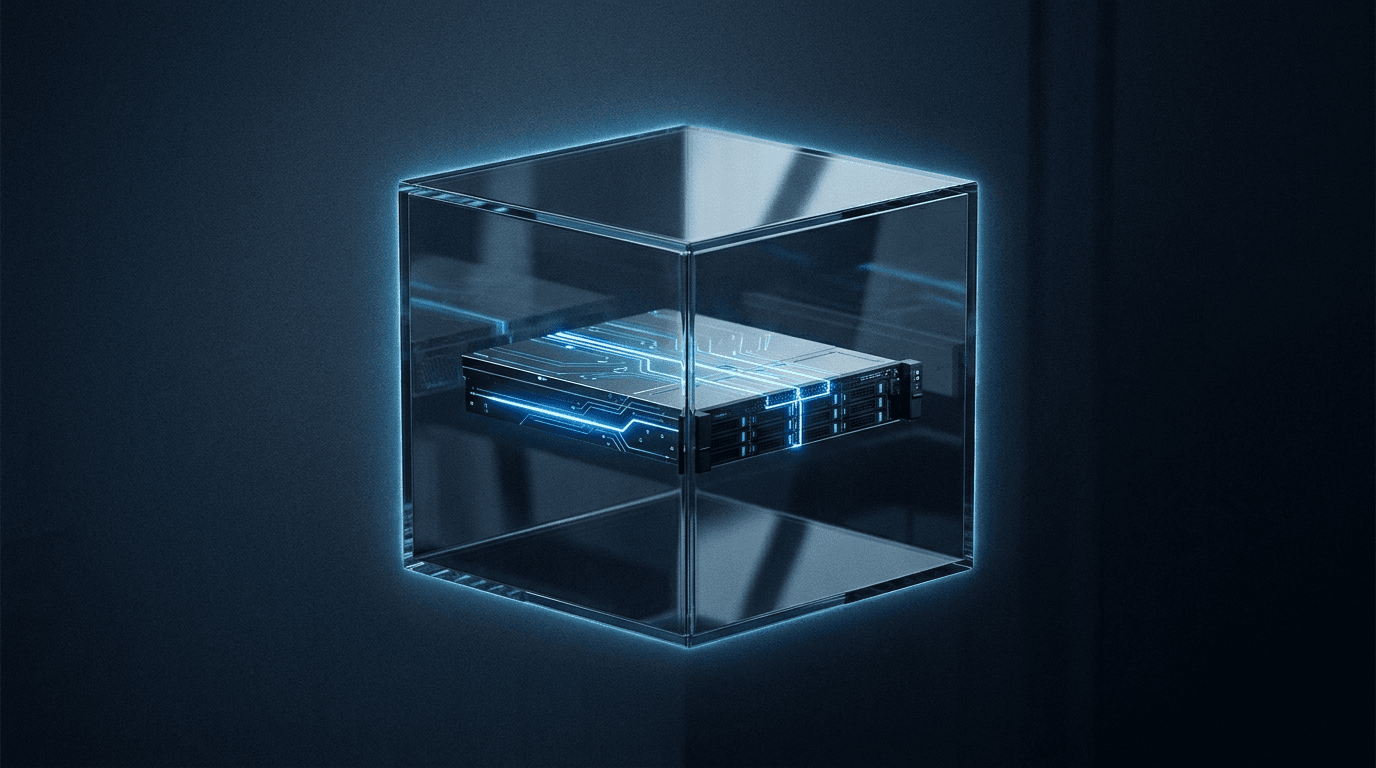
An air gap is exactly what it sounds like: a gap of air between your system and the outside world. The machine doing the work has no path to the internet. Nothing it touches can be sent out, because there's no road for it to travel on.
Air-gapped AI puts the whole assistant, the model, your files, the work it does, inside that gap. It runs on hardware in your building, and that hardware is sealed off from the public internet. You can ask it to read a document, draft a report, or answer a question about your own records, and the answer comes back without a single byte crossing your perimeter.
Compare that to cloud AI, where every prompt is a trip out of the building to someone else's computer. With an air gap, there is no trip. There's nowhere for the data to go.
When it's the only honest answer
Plenty of businesses are fine with private AI that stays in the building but still has a normal internet connection for updates. Air-gapping is for the cases where even that connection is too much:
- Regulated health and legal work where a single exposure of patient or client data is a reportable event, not an inconvenience.
- Defense, intelligence, and critical infrastructure, where the threat model assumes someone is actively trying to reach your systems.
- Government and sovereign data that, by law or policy, cannot reside on or transit foreign or third-party networks.
- Financial and trade-secret operations where the data itself is the entire value of the business.
If a breach in your world means a headline, a lawsuit, or a national-security review, not a strongly worded email, air-gapped is the conversation to have.
The honest trade-offs
Air-gapping isn't free, and anyone who tells you otherwise is selling. When you cut the cord, you give up the easy conveniences a connection provides:
- Updates take a deliberate process instead of happening automatically over the wire.
- The model's knowledge is the knowledge you loaded, not a live link to the open internet.
- Setup is more involved, because the whole point is that nothing reaches in or out without you deciding.
For the businesses that need it, those trade-offs aren't drawbacks, they're the product. The friction is the security working.
How we approach it
TechFides builds private AI that runs on hardware you own. For most clients that means in-the-building and private. For the ones who need it, we deploy the same capability air-gap capable, sealed off from the internet entirely, configured so the data physically cannot leave.
The point isn't to be dramatic about security. It's to tell you the truth: if your work genuinely can't have data leave the building, "private cloud" and "we don't train on your data" are not the same as a gap of air. Only one of those is a guarantee you can stand behind.
If that's the bar you're held to, you don't have to choose between modern AI and keeping your data inside the walls. You can have both. Own your AI, and, when it matters this much, seal it in.
Like this? Get the next one Wednesday.
One email per week. No marketing filler. Unsubscribe anytime.